On Street Charging Points
Central government is investing heavily in the installation of charging points (CP’s) for electric vehicles.
The council, with its charge point operator Connected Kerb are currently installing around 270 points, as part of the first phase of supported funding.
For Shifnal these locations have been selected:
The Government has recently announced further support for accelerating the installation of more charging points and specifically to encourage those who are unable to charge easily at home to purchase vehicles. Government has indicated that Shropshire can access an additional £2.4m of funding to support this initiative subject to application. Reference the following link Apply for Local Electric Vehicle Infrastructure (LEVI) funding – GOV.UK (www.gov.uk)
To help with the application process and to provide additional help, the Council has joined a consortium of local authorities led through Midlands Connect (MC). This will help to secure the available funding and learn from the experience of others who are developing, for example procurement tools to ensure VfM.
The Council has already engaged with MC and using theoretic modelling tools postcodes have been identified in Shropshire where additional CP’s might be installed to meet the Government’s investment objectives. Specific locations will be identified as programmes are developed and plainly in consultation with members and local communities.
It is anticipated the second wave of CP’s will begin after the current phase of installation is complete and in the middle to latter stages of 2024.
Green Spaces
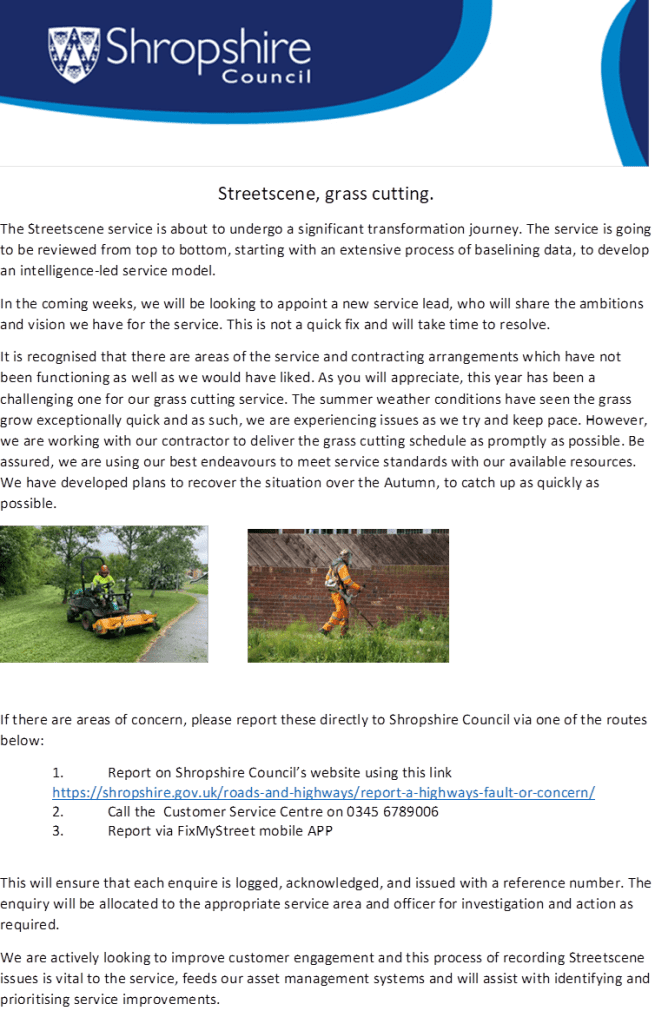
As you may be aware, Shifnal Town Council currently has limited capacity to maintain green spaces in the Town and relies on Shropshire Council to maintain areas such as the Town Centre. There have been a number of complaints regarding the state of the Town Centre after so much CIL money was invested to improve the area. I have reported this to Council Officers and also through Fix My Street and I encourage members of the public to do the same.
Note from Shropshire Council regarding grass cutting:
Shropshire Full Council Meeting
I attended Shropshire full council on Thursday 21st September. Agendas and minutes can be found here: https://shropshire.gov.uk/committee-services/ieListMeetings.aspx?CId=125&Year=0
Pyrolysis Project
Of particular interest was the report and recommendations to convert bio-mass to char:
- Executive Summary
2.1. The Shropshire Plan’s Healthy Environment priority highlights the importance of investment and joint working to tackle climate change and maintain, protect, and enhance our outstanding natural environment.
2.2. Our estate requires the removal of thousands of tonnes of biomass (renewable organic material from plants) each year which is currently a financial burden. In some cases, this results in some areas not being managed as effectively as they could be for the best biodiversity results. Unmanaged woodland being one example. This is exacerbated by ash die-back disease which is leading to thousands of ash trees alongside our roads or in public spaces needing to be felled for safety reasons. Low grade biomass is increasing in value as alternative uses are being found and aspects of the circular economy are being developed. (an economic system based on the reuse and regeneration of materials or products, especially as a means of continuing production in a sustainable or environmentally friendly way)
2.3. Our Climate Change Strategy has a target of net zero carbon emissions by 2030. Without the ‘negative emissions’ provided by the Veolia waste contract, Shropshire Council’s carbon emissions in 2021 to 2022 were around 33,565 tonnes of CO2e.
Emission reduction alone is not sufficient. We also need to consider Greenhouse Gas Removal methods that actively remove carbon dioxide from the atmosphere.
2.4. Greenhouse Gas Removal methods like tree planting can help reduce net emissions but trees are slow growing and are at risk from disease, fire, and extreme weather events. Alternative forms of carbon removal such as pyrolysis and Enhanced Rock Weathering diversify our portfolio of removal methods and have considerable economic and environmental co-benefits.
2.5. Pyrolysis is the thermal breakdown of materials (in our case plant matter) in the absence of oxygen. The heat drives off gasses and oil and what is left is mostly carbon in the form of char. If this char is burnt again as fuel, it’s known as Charcoal. If it’s kept as char and used in other ways, it is often called biochar; sometimes also activated charcoal. The primary difference from charcoal is the higher temperatures used and typically smaller particle size of the charred material.
2.6. The combustible gasses and oils driven off are burnt in a generator to produce clean renewable electricity, around 35% of which is used to power the unit. The rest can be sold to nearby businesses and residences, or to the grid. Residual heat could also be used in district heat networks where available.
2.7. Biochar can remain in soils or materials for hundreds, and even thousands of years without degrading. Charcoal in archaeological excavations of fire pits provide a good demonstration of this. Biochar is typically between 60% and 80% pure carbon. We measure carbon emissions in weight of ‘Carbon Dioxide equivalent’. From pure carbon this requires multiplication by 3.67 to add the weight of the two oxygen atoms. This means that 1 tonne of biochar effectively stores between 2 to 3 tonnes of Carbon Dioxide. This is a Greenhouse Gas Removal method with the carbon almost permanently removed from the atmosphere.
2.8. Biochar has a fast developing and potentially profitable market with a multitude of uses in a wide range of sectors including, agriculture, horticulture, arboriculture, industrial production and construction. Biochar is increasing in use as a soil improver and a means of retaining nutrients on farmland. This is partly driven by increasing fertiliser costs and is being seen as a greener alternative. Sales for horticultural use are forecast to increase as a result of the upcoming ban on the sale of bagged peat compost coming into force in 2024. Biochar stores water in the soils as well as nutrients.
2.9. Other innovative ‘non-carbon’ uses of biochar include “preventing agricultural run-off of nutrients and pesticides that can degrade water quality, reducing nitrogen losses during composting, preventing ammonia release from poultry farm buildings and increasing methane yields during anaerobic digestion (AD)” (Ref: ongoing Nottingham University research).
2.10. The acquisition of a pyrolysis plant has been assessed and it has been determined that it will assist the Council in meeting its sustainability and carbon reduction targets as well as being commercially viable.
2.11. This project seeks to promote and research the benefits of utilising pyrolysis technology as a way of tackling climate change. Through the acquisition and operation of a demonstrator plant, valuable firsthand knowledge will be obtained which will help formulate the strategy for possible future expansion.
2.12. Three possible locations have been identified for the demonstrator project which are currently being considered by the project team.
The full report can be found here: https://shropshire.gov.uk/committee-services/documents/s35617/Pyrolysis%20Project-03022023%201355.pdf
Annual Report for Children and Education
A substantial report was produced on the County’s Children and Education services which was recently graded overall as Good by Ofsted. There is a lot of detail in the report, which can be viewed at https://shropshire.gov.uk/committee-services/documents/s35615/Annual%20Report%20of%20the%20Portfolio%20Holder%20for%20Childrens%20Services%202022-23.pdf
The budget is large, and increasing due to an increased demand for support, an increase of 8% looked after children and children placed for adoption and placements through early permanence has increased. However, despite this, all of Shropshire Council’s Children’s Homes are Ofsted rated Good or Outstanding.
Key headlines:
a. An increasing in demand for statutory support particularly children experiencing physical harm.
b. An increase in request for assessment and support for our disabled children.
c. Experienced workforce challenges, some workers have left, but our rate of retention is improving. We have for the first time focussed on converting our long-term agency staff to permanent contracts.
d. Undertaken a review of our Early Help Service which has highlighted that the impact of reducing investment has led directly to the increase in demand on statutory services. An Early Help Transformation programme has been launched.
e. Evidenced that CHAST (Compass Help and Support Team) launched in September 2022 has started to reduce the number of children requiring a Social Work Assessment and therefore a Statutory Service.
f. Children looked after numbers have increased by 8% in year.
g. Stepping Stones has achieved a total of 55 children avoiding becoming looked after and 20 children have stepped into a home setting, resulting in a saving to the Council £6.83 million and better outcomes for those children.
h. More children ceased to be looked after than became looked after in year.
i. With the foster carers fee uplift, we have seen a significant increase in enquiries & applications giving us the potential over time to be less reliant on external placements.
j. Children placed for adoption and placements through early permanence has increased.
k. All our Children’s Homes in Shropshire are Ofsted rated Good or Outstanding.
Highlights include:
a. High parental preferences for primary and secondary applications for school places, both above national average.
b. High uptake of Free Early Education at 2, 3 and 4 for eligible families, all above the national average.
c. Maintained strong provision across the Early Years providers with more than national averages being judged Good or Outstanding.
d. Maintained strong school age provision (primary and secondary) with the percentage being judged Good or Outstanding in line with national averages.
e. Emerging 2023 primary school outcomes data indicates that educational standards have risen in a number of areas, compared to 2022.
f. Significant increases in attendance at primary and secondary, c.5% higher than 2021/22, and both above national average. Continuing to reduce persistent absence at primary and secondary with fewer children and young people persistently absent than national averages.
g. Since September 2022 increased specialist provision in Shropshire by commissioning more than 100 additional places in pre-16 state-funded special schools. This is more than a 25% increase in places.
h. Introduced ‘Developing Inclusive Practice’ days to bring together leaders from the education, health and social care system to share opportunities and challenges to improve outcomes for children and young people with SEND.
i. Co-produced the Shropshire Ordinarily Available Provision (SOAP) framework to develop a clear and more consistent expectation of what support should be provided to all children and young people through high quality teaching and SEND Support. This will be implemented from the start of the 2/23/24 academic year.
j. Educational Psychology capacity continues to grow as the impact of our recruitment and retention strategy strengthens our team. This is enabling further support to our education settings and children and young people.
k. The percentage of 16 and 17 year olds in Shropshire who are not in education, employment or training (NEET) is 2.3%, lower than the national average of 2.8%. More young people with an EHCP are accessing a Supported Internship in Shropshire than the West Midlands average.
l. The Shropshire Virtual School continues to provide strong support to children looked after (CLA) by Shropshire. Attendance has improved for
children looked after and there have been no permanent exclusions for this group.
m. The quality of Personal Education Plans (PEPs) continues to increase and support the development of children supported by the virtual school. Good quality PEPs are in place for all year groups now, from our youngest children through to our young people studying in Post 16.
n. Shropshire Music Service is more inclusive, offering a range of free ensembles weekly at various locations around the county, resulting in attendance trebling and more new engagers in music.
 Edward Bird - Councillor for Shifnal South and Cosford